


Temple of Apollo in Syracuse: What Ortigia’s Oldest Ruins Tell Us
Entering Ortigia from Corso Umberto I, the Temple of Apollo is one of the first monuments you come across. Today, only a few columns, part of the cella and other elements of the original structure remain, but in the 6th century BC this was one of the most important temples of ancient Greek Syracuse and one of the earliest examples of Doric architecture in Sicily.
To really understand what you see today, however, you need to look beyond the ruins. Over the centuries, the Temple of Apollo was transformed several times, becoming first a church, then a mosque, later a Christian place of worship once again, and finally part of a military barracks.
In this article, we will look at what remains of the Temple of Apollo in Syracuse, what it may originally have looked like, and which traces still reveal the different stages of its long history. For a broader overview of the monument, you can also read our guide to the Temple of Apollo in Syracuse.
What the Temple of Apollo Looked Like in the 6th Century BC
To imagine the Temple of Apollo before the many transformations it underwent over the centuries, you need to picture a building very different from the ruins visible today. Built in the early decades of the 6th century BC, it belongs to the archaic phase of Doric architecture and is considered one of the oldest stone-built Doric temples in Sicily.
The temple had a rectangular plan and was surrounded by a colonnade: six columns along the shorter sides and seventeen along the longer ones. The columns, carved from large monolithic blocks of limestone, stood very close together and supported a structure that must have appeared particularly massive compared with Doric temples built in later centuries.
At the centre was the cella, the sacred chamber devoted to the deity, preceded by the pronaos. The main entrance faced east, a common arrangement in Greek temples. Its original appearance was also less “white” than the bare stone might suggest today: some architectural and decorative elements were finished with painted terracotta and bright colours.
The Temple of Apollo therefore belongs to a period when Greek architects were beginning to transfer into stone solutions that had previously been used mainly in timber construction. This also explains why its proportions and certain architectural details differ from those of the great Doric temples of the Classical period.

What to Look for Among the Ruins Today
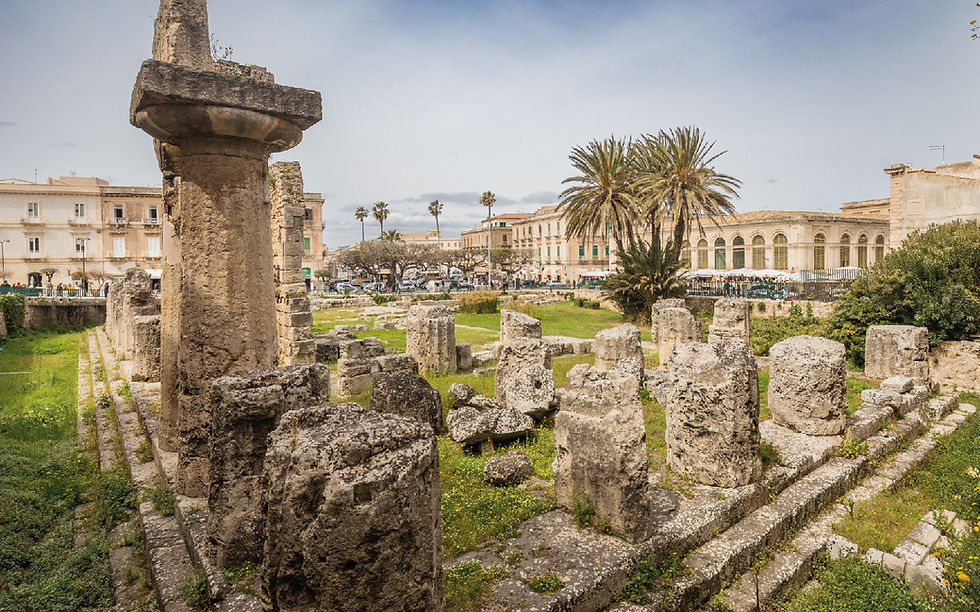
Seen from Largo XXV Luglio, the temple’s original shape is not immediately easy to recognise. The surviving remains, however, still make it possible to identify some elements of the archaic structure and, above all, to understand how imposing the building once was compared with what is visible today.
The Columns and the Cella Wall
Among the most recognisable remains are two columns still standing on the southern side, together with sections of the colonnade and the cella. The cella itself formed the core of the building: according to the reconstruction provided by the Municipality of Syracuse, it was divided into three aisles by two rows of internal columns.
The very elongated proportions of the plan and the short distance between the columns are characteristic of archaic Doric architecture. Looking at these features helps us see the ruins not as isolated fragments, but as the remains of a structure that once occupied much of the area visible today.
The Inscription Dedicated to Apollo
One of the most important details of the Temple of Apollo is an inscription in archaic Greek carved into the stylobate, the base on which the columns stood. It is this inscription that links the monument to the cult of Apollo and mentions the name Kleomenes, who was probably involved in the construction of the building.
The full interpretation of the inscription is still debated by scholars, so overly definitive translations are best avoided. Its general meaning, however, refers to the construction of the temple and especially its colonnades. This is significant because building a structure of this size with monolithic stone columns was, at the time, a remarkable technical achievement.
From Greek Temple to Church, Mosque and Barracks
The history of the Temple of Apollo did not end with the decline of Greek Syracuse. On the contrary, one of the reasons the site is so interesting is the number of transformations it underwent over the centuries.
During the Byzantine period, the ancient temple was adapted into a Christian basilica, with its interior modified to suit the needs of the new form of worship. During the Islamic rule of Syracuse, the building was instead used as a mosque, before becoming a church once again after the Norman conquest.
The transformations continued in later centuries. In the 16th century, part of the ancient structure was incorporated into Spanish military barracks, while more recent buildings gradually concealed almost the entire temple.
The situation began to change between the 19th and 20th centuries, when excavations and demolitions brought a significant portion of the Greek structures back to light. For this reason, the remains visible today do not tell only the story of 6th-century BC religious architecture: they also preserve traces of a building that was repeatedly reused and adapted throughout the different periods of Syracuse’s history.
Why the Temple of Apollo Now Lies Below Street Level
Another detail that immediately stands out is the difference in height between the temple and the surrounding streets. The archaeological remains lie several metres below the present-day level of Largo XXV Luglio.
This is connected to the long urban stratification of Ortigia. Over the centuries, new buildings and changes to the city gradually accumulated over older structures, altering the urban ground level. The Temple of Apollo itself remained incorporated into later buildings for a long period of time.
The monument gradually became visible again thanks to demolitions and archaeological excavations carried out between the 19th and 20th centuries. The Municipality of Syracuse specifically refers to systematic excavations that cleared the area of later structures and brought the ancient temple back to light.
The difference in height visible today therefore makes one aspect of Ortigia’s history particularly clear: the modern city developed over centuries of earlier buildings, transformations and historical phases, with the Temple of Apollo providing one of the most visible examples.
See the Temple of Apollo During a Walk Through Ortigia
The Temple of Apollo is located in Largo XXV Luglio, just after the entrance to Ortigia. Its position makes it easy to include in a walk through the historic centre, especially because the site can be viewed directly from the pedestrian area that surrounds it.
At present, the archaeological area is not normally open for interior visits, so the monument is generally viewed from outside, while any special openings are announced separately by the relevant authorities. If you would like to check whether access is possible during your stay, it is therefore best to consult the latest information before visiting.
For guests staying at Algilà Ortigia Charme Hotel, the Temple of Apollo is easy to reach on foot through the streets of Ortigia.
Precisely because it stands at the entrance to the island, the temple is also a useful starting point for understanding Ortigia’s history: from the remains of Greek Syracuse to the transformations that, century after century, shaped the city visible today.