


Historic Palaces of Syracuse: From the Middle Ages to the Baroque Architecture of Ortigia
In Ortigia, history isn't found only in its famous monuments. Simply walk through its streets and look up to discover ancient doorways, decorated balconies, Gothic windows and Baroque façades that reveal centuries of change.
From medieval residences to the aristocratic mansions of the 18th century, the historic palaces of Syracuse preserve traces of the families, architectural styles and events that have shaped the city's past.
Many of these buildings are just a short walk from one another and can easily be explored on foot. By choosing to stay in Ortigia in one of the rooms at Algilà Hotel, you can reach them on foot and take your time admiring their architectural details.
Let's explore some of the most interesting historic palaces in Syracuse, what makes them special and where to find them.
Palazzo Montalto: A Glimpse of Medieval Syracuse

Our walk begins at 4 Via dei Mergulensi, just a few steps from Piazza Archimede. Here stands Palazzo Montalto, built in 1397 for the noblewoman Macciotta Mergulese and later acquired by the Montalto family.
It is one of the finest examples of Chiaramontan Gothic architecture in Syracuse. Its façade is particularly interesting for its three different types of windows: a single-light window, a double-light window and a triple-light window, featuring twisted columns and floral decorations carved into the stone. Above the entrance, you can still see the Latin inscription commemorating the palace's construction.
Today, the building is best appreciated from the outside, as there are no regularly scheduled visits to its interiors. To learn more about its history and architectural features, read our dedicated article on Palazzo Montalto in Syracuse.
Palazzo Vermexio: The Former Senate Palace

From Palazzo Montalto, continue towards Piazza Duomo, where you'll find Palazzo Vermexio, at 4 Piazza Duomo, now home to Syracuse's City Hall.
Built between 1629 and 1633 to a design by Giovanni Vermexio, the building features a relatively restrained ground floor and a richly decorated upper level, with balconies, niches and ornamental capitals.
One curious detail to look for on the façade is a small lizard carved into the cornice, a distinctive feature the architect used to sign some of his works. Inside, the palace also houses the 18th-century Senate Carriage, while beneath the building lie the remains of an ancient Ionic temple.
As the palace is still used for administrative purposes, there is no regular tourist route through the entire building. For information about possible access to its interiors, contact the Municipality of Syracuse.
Palazzo Beneventano del Bosco: An 18th-Century Noble Residence
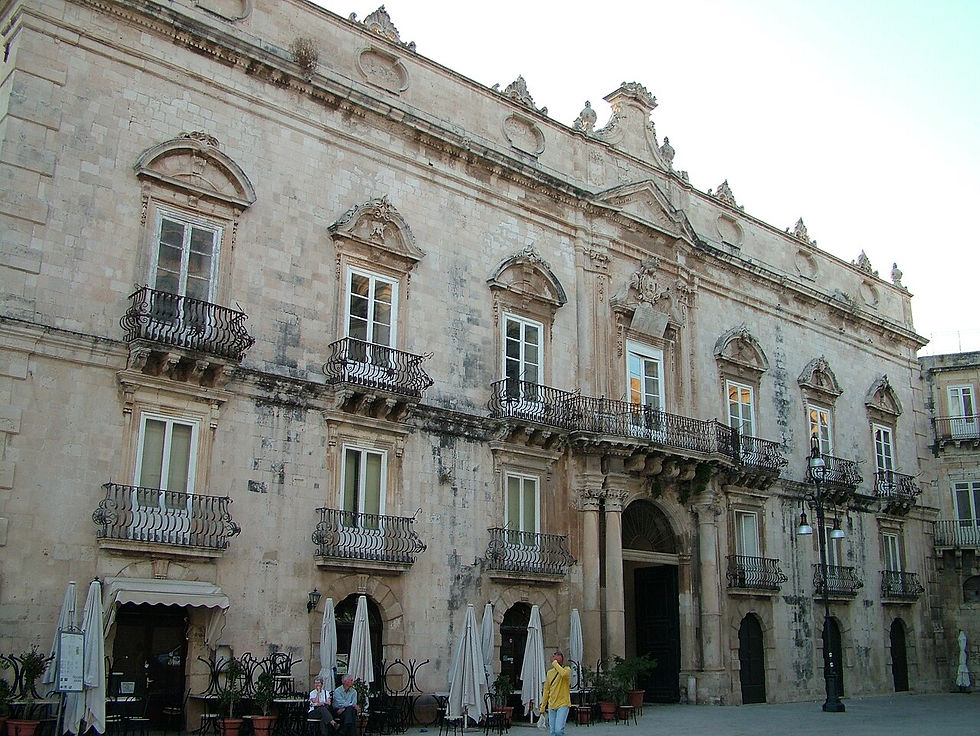
Just across Piazza Duomo stands Palazzo Beneventano del Bosco, one of the finest examples of Baroque architecture in Ortigia.
The building owes its present appearance to a major renovation carried out in 1779 by architect Luciano Alì, who transformed an older structure. Its façade features wrought-iron balconies, elaborate stone decorations and an imposing central entrance crowned by the family's coat of arms.
Behind the 18th-century façade, parts of the medieval building survive, while the inner courtyard features an impressive grand staircase. This combination of architectural periods is precisely what makes the palace so interesting.
Located in Piazza Duomo, the palace is privately owned and does not publish regular tourist visiting hours. For information about possible visits, consult the Palazzo Beneventano del Bosco website.
Palazzo Borgia del Casale: Inside Syracuse's Aristocratic Past
Continue towards the southern end of Piazza Duomo and turn into Via Pompeo Picherali. At number 10, you'll find Palazzo Borgia del Casale.
Rebuilt in 1760 on the site of an earlier building dating back to the Aragonese period, the palace preserves rooms decorated with frescoes, stucco work and Rococo motifs. Its piano nobile, or main reception floor, includes several historic rooms, such as the Hall of Mirrors and the Hall of Cupid and Psyche.
Unlike some of Ortigia's other noble residences, Palazzo Borgia del Casale is also open to visitors inside. According to its official website, an audio-guided tour costs €8 per person, with no advance booking required. Private guided visits are also available by appointment.
Opening hours may vary, so check the official website for tickets and visitor information before planning your visit.
Palazzo Bellomo: From Medieval Residence to Museum

The final stop is at 14–16 Via Capodieci, a short distance from Palazzo Borgia del Casale.
Palazzo Bellomo dates back to the Swabian period and was extended in the 15th century by the Bellomo family. Today, it houses the Regional Gallery of Palazzo Bellomo, dedicated to medieval and modern art from southeastern Sicily.
A visit offers the chance to admire both the building's architecture and its art collection, which includes important works such as the Annunciation by Antonello da Messina.
The museum is open to visitors with an admission ticket. The standard admission fee listed on the institutional website is €8, with a reduced ticket available for €4. However, both ticket prices and opening hours should be checked before visiting, as they may change.
For the latest information, consult the official page of the Regional Gallery of Palazzo Bellomo.


Comments